
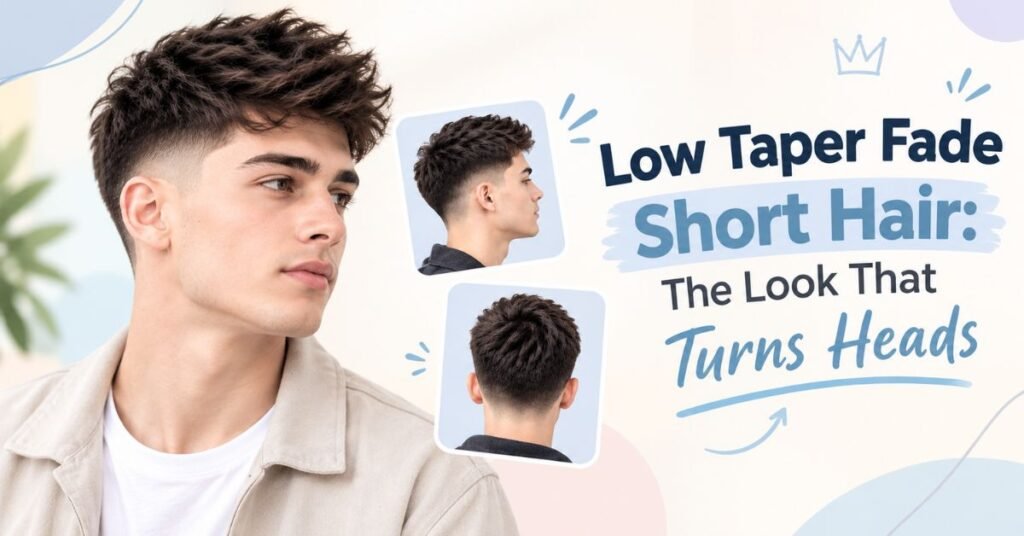
Low taper fade short hair is the cut that looks right in a Monday meeting and just as right on a Saturday night. It keeps the sides clean, leaves the top free to style, and never looks like you tried too hard.
If you have been scrolling through barber photos and wondering which version suits you, this guide covers it. You will learn what low taper fade short hair really means, which styles work best, how to match the cut to your face shape and hair texture, and exactly what to say in the barber’s chair.
Everything here follows standard barbering practice and the grooming habits that keep a cut looking fresh. Let’s get into it.
What a low taper fade is for short hair
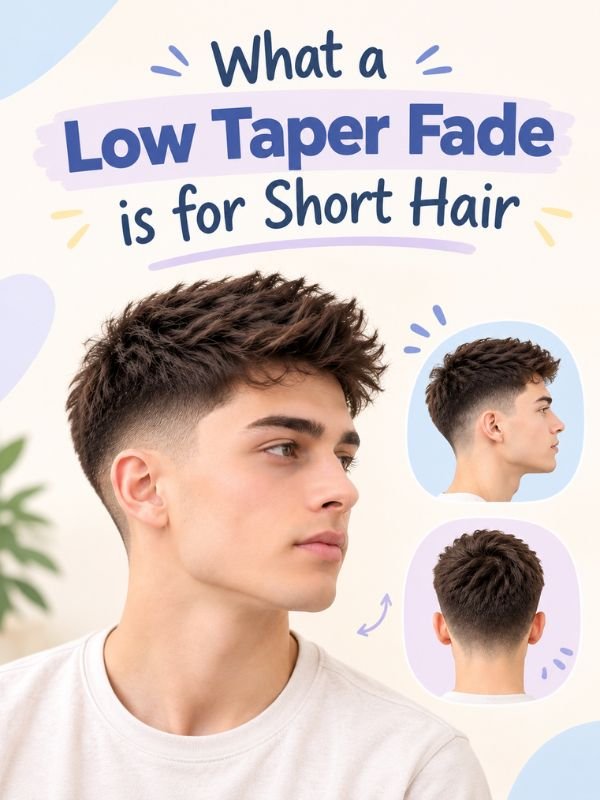
A low taper fade short hair cut shortens the hair gradually around the sides and back. The shortening starts low, near the sideburns, the edge of the ear and the nape, and it stays there. Everything above that line keeps its length, so the blend looks subtle rather than dramatic.
Two terms get mixed up here. “Taper” describes the gradual change in length. “Fade” describes hair blending down toward the skin. A low taper fade combines both with a restrained finish: the hair gets very short at the edges only, and little or no bare skin shows.
That restraint is why low taper fade short hair works for offices, interviews, weddings and everyday life.
Quick definition: A low taper fade is a haircut where the sides and back gradually shorten, starting low near the ears and neckline, and blend into longer hair on top.
How a low taper Compares to mid and high fades
The main difference is where the shortening begins. A low taper starts near the ear and nape, a mid taper starts around the temple, and a high taper starts higher up the head.
| Feature | Low Taper | Mid Taper | High Taper |
| Starts at | Sideburns, ear edge, nape | Around the temples | Upper temples and above |
| Contrast | Subtle | Moderate | Bold |
| Overall look | Classic, understated | Balanced | Sharp, edgy |
| Typical upkeep | Every 3–5 weeks | Every 2–4 weeks | Every 2–3 weeks |
| Best for | Office and everyday wear | All-round use | Trend-led styles |
Most men who choose low taper fade short hair do so because the grow-out is gentle. A high fade shows regrowth quickly because the contrast is stronger. A low taper simply softens.
Low taper fade vs low fade: the Difference people miss
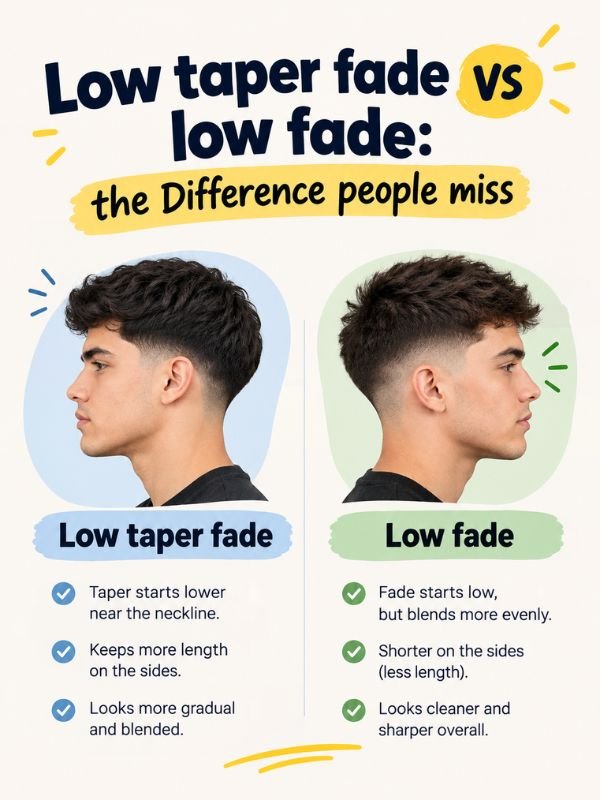
These two cuts sound identical, but they are not.
- Low taper: The hair shortens gradually but usually stays on the skin’s surface as short hair. Very little bare skin shows.
- Low fade: The hair blends down to the skin, or close to it, so you see a clear gradient.
If you want a soft, classic outline, ask for a low taper. If you want a visible skin gradient with the fade sitting low, ask for a low fade. Many barbers blend both, which is why showing a photo helps. For low taper fade short hair, the taper is the star, and the fade is only a light finish at the edges.
Why the low taper fade suits short hair
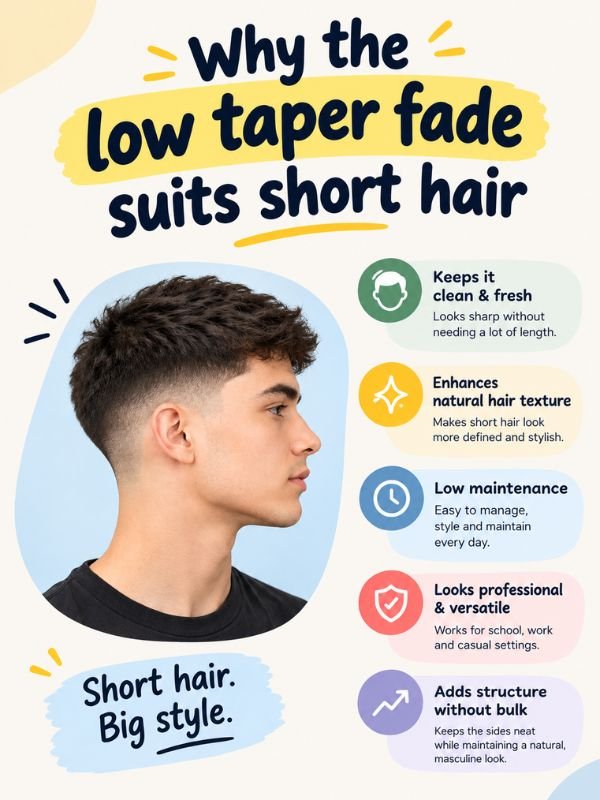
Short hair has little room to hide a messy outline. Low taper fade short hair gives you a defined shape without cutting much length from the top. The cut frames the face, tidies the neckline and makes even a simple style look deliberate.
It stays low-maintenance between cuts
Because the taper begins low, regrowth blends in rather than standing out. You can stretch a cut a week or two longer than you could with a skin fade and still look tidy.
Here is why low taper fade short hair is easy to live with:
- Regrowth looks soft instead of fuzzy
- The top needs very little product
- Morning styling takes under five minutes
- Fewer barber visits keep costs down
It is not zero upkeep, though. The neckline and sideburns will soften first, so a quick clean-up tends to be enough.
It works across hair types
One of the best things about low taper fade short hair is its flexibility. Straight, wavy, curly and coily textures all take a taper well. The cut simply adapts: straight hair gets a crisp edge, curls get a clean frame, and coily hair gets definition. You will find specific advice for each texture further down.
Best low taper fade short hair styles
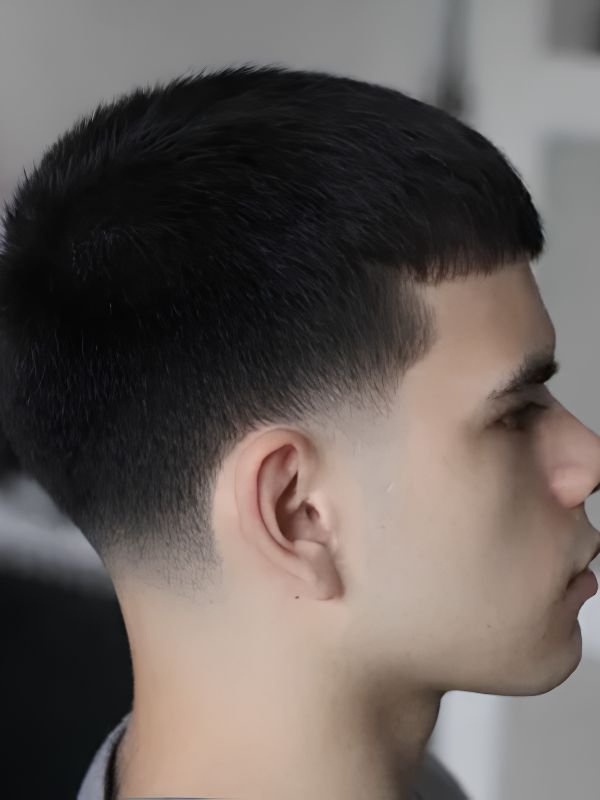
The taper stays the same. The top is where you choose your personality. These five pairings are the most reliable.
Crew cut with a low taper
The crew cut is short on top, slightly longer at the front, and easy to maintain. Pair it with a low taper and the result is clean, athletic and quick to style. It suits busy people, military-inspired looks and anyone who wants a no-fuss routine.
Ask for: a short, even top with a slightly longer front and a low taper around the ears and neck.
Textured crop with a low taper
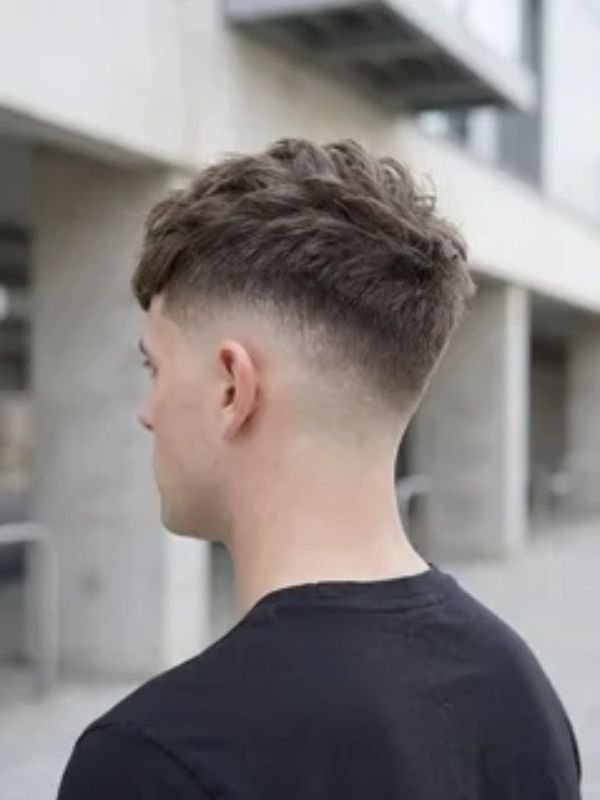
A textured crop has a choppy, matte top cut short, with a forward-brushed fringe. It adds movement without needing length. With a low taper, it feels modern and slightly relaxed, which is why low taper fade short hair looks so good in this style. A little clay or paste does all the work.
Ask for: a cropped, point-cut top with a low taper blended into the sides.
Buzz cut with a low taper
A buzz cut is the simplest way to wear this cut. The top is clipped to one even length, and the taper gives the edges a refined finish. It looks minimal and confident, and it needs no styling at all. A tapered buzz is a good choice if you want low taper fade short hair with zero product.
Ask for: one guard length on top, with a low taper starting just above the ears.
Slick back with a low taper
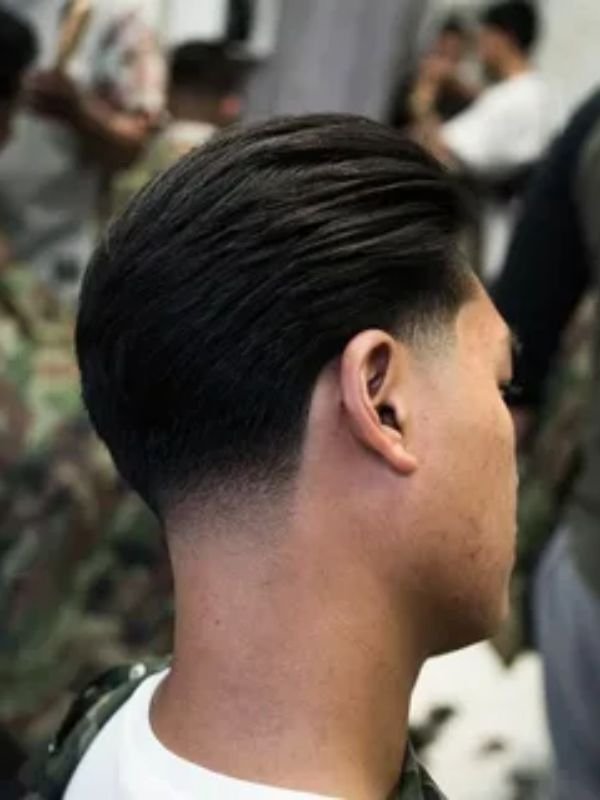
For a sleeker look, grow the top slightly longer and comb it back. The low taper keeps the sides tidy so the slick back feels polished rather than heavy. It works well for formal events and for anyone who likes a groomed, vintage-leaning style.
Ask for: two to three inches on top, combed back, with a low taper on the sides and nape.
Curly top with a low taper
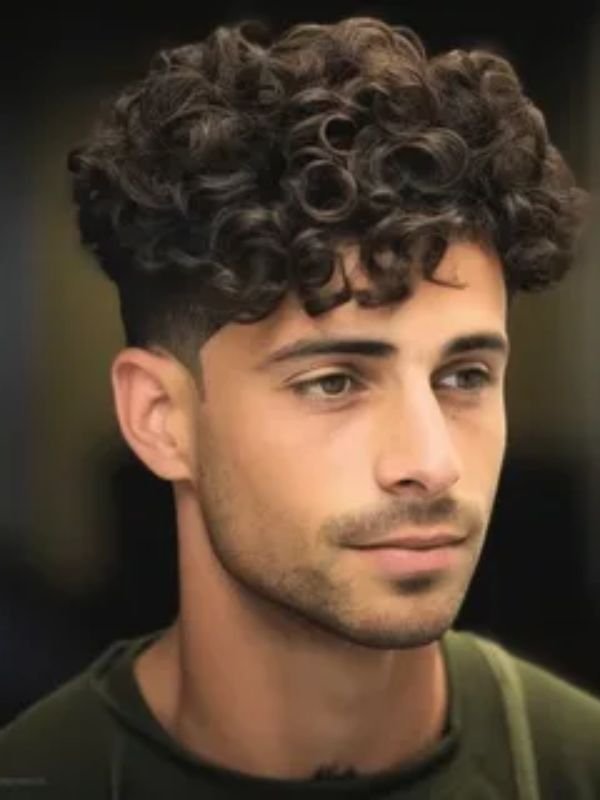
Curls on top with a low taper is one of the cleanest contrasts in men’s hair. The taper tames the sides while the curls stay full and natural. This style shows off texture, and low taper fade short hair frames it neatly without flattening it.
Ask for: curls left at a natural length on top, with a low taper that follows the hairline.
| Style | Top Length | Styling Effort | Best For |
| Crew cut | Short | Very low | Busy routines |
| Textured crop | Short–medium | Low | Modern casual |
| Buzz cut | Very short | None | Minimal upkeep |
| Slick back | Medium–long | Medium | Formal settings |
| Curly top | Medium | Low–medium | Natural texture |
Choosing a low taper fade for your face shape
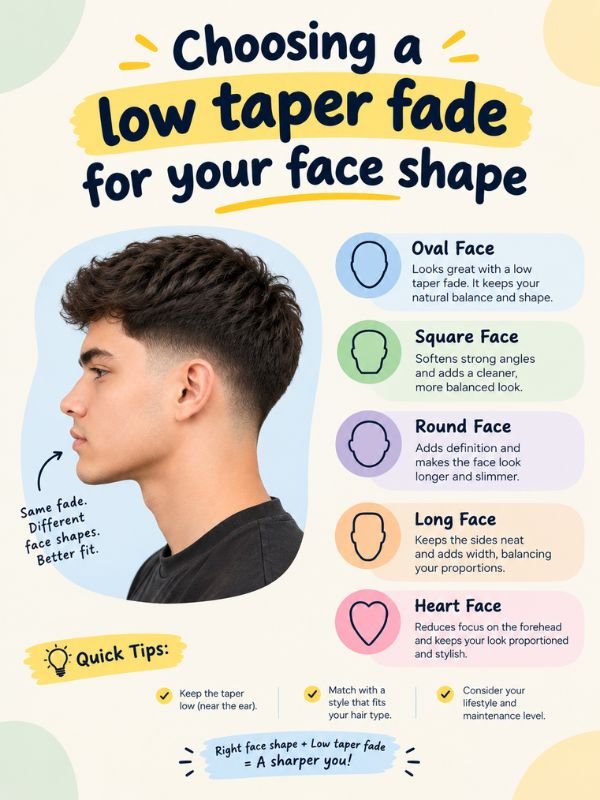
Your face shape helps decide how high or soft the top should be. The low taper is flattering on nearly everyone, but small tweaks sharpen the result.
| Face Shape | What to Aim For | Why It Works |
| Oval | Almost any top | Balanced proportions suit most styles |
| Round | Height and volume on top | Adds length and visual structure |
| Square | Soft, textured top | Softens a strong jawline |
| Oblong | Fringe or forward texture | Reduces the look of length |
| Heart | Side-swept or textured fringe | Balances a wider forehead |
| Diamond | Fuller top with a soft fringe | Balances prominent cheekbones |
If you are unsure, start with the textured crop. It flatters more shapes than any other pairing with low taper fade short hair.
Low taper fade for straight, wavy, curly, and coily hair
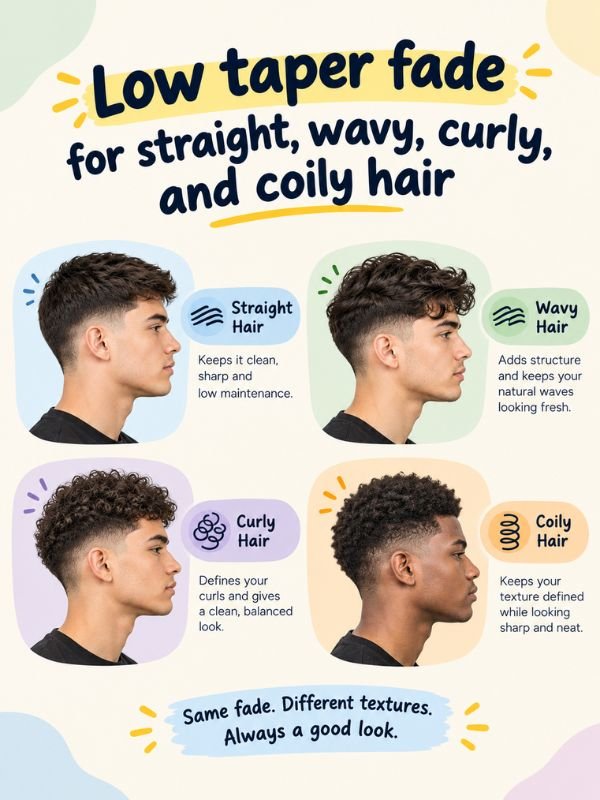
Texture changes how the cut sits and how you style it. Here is what to expect.
Straight hair
Straight hair shows every line, so a precise taper looks very crisp. Keep the top lightly textured so the cut does not look flat. Fine, straight hair benefits from a bit of volume powder or sea salt spray. Low taper fade short hair on straight strands is probably the easiest version to maintain.
Also, read this: Low Taper Fade Straight Hair Boys
Wavy hair
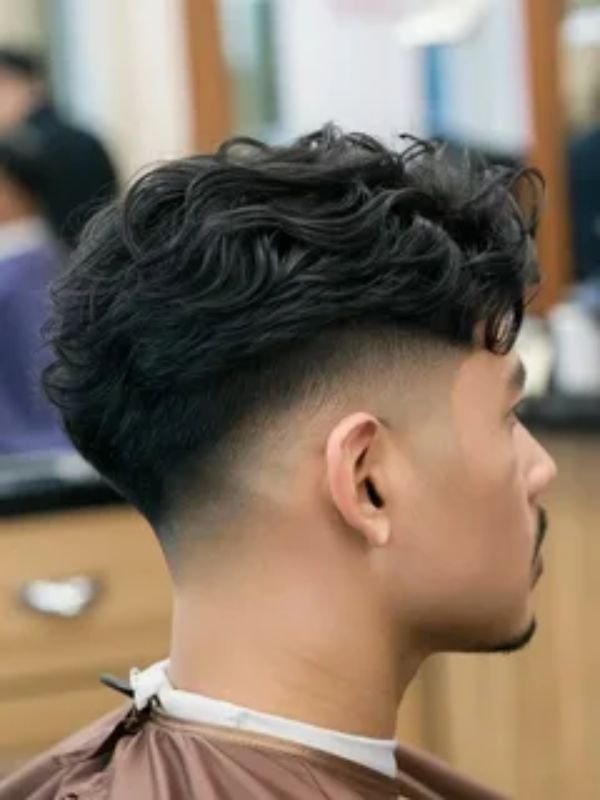
Wavy hair gives natural movement that works well with a taper. Leave a little length on top so the waves can show. A light cream or mousse defines the pattern without weighing it down. This is a good texture for a messy, relaxed finish.
Curly hair
Curls need room, so keep the top long enough to form. The low taper keeps the sides neat while the curls stay defined. Use a curl cream on damp hair and let it dry naturally or with a diffuser. Curly hair with low taper fade short hair looks best when the curls are moisturised and the edges are crisp.
Coily hair
Coily textures hold a taper beautifully, because the tight pattern keeps its shape. A sharp lineup and a well-blended low taper give a defined, polished look. Moisture is the priority here: use a leave-in conditioner and a light oil to keep coils healthy and the cut looking sharp.
What to ask your barber for a clean low taper
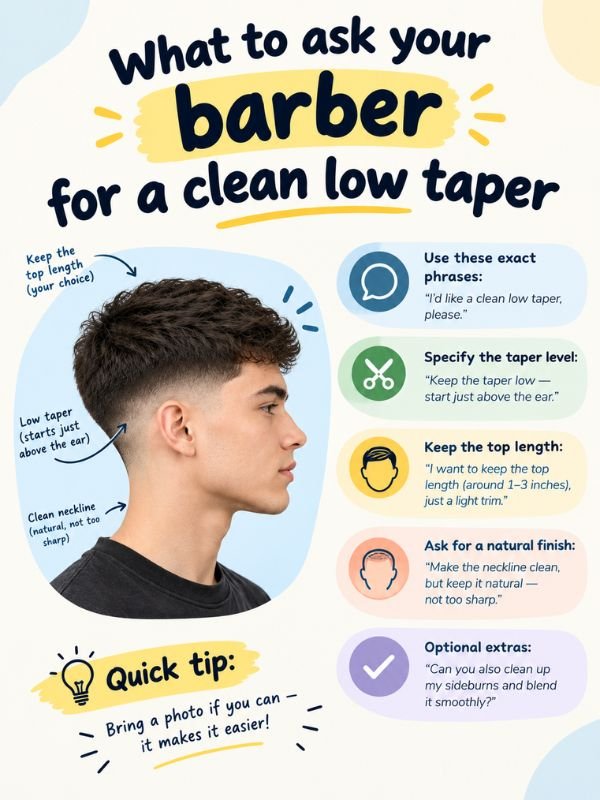
Barber communication makes the difference between “close enough” and “exactly right.” Use this simple approach:
- Bring a photo. Pictures remove most of the guesswork.
- Name the cut. Say “low taper” clearly, and mention whether you want skin showing or not.
- Choose the starting point. Say you want it to begin just above the ear and follow the natural hairline.
- Decide the top. Give a length or a style, such as crew cut, crop or slick back.
- Confirm the neckline. Say whether you want it blocked, rounded or tapered.
- Ask about the finish. Mention whether you want a lineup or a natural edge.
A simple script that works: “I’d like a low taper fade short hair cut. Start just above the ear and blend into the top, keep the top about an inch long, and finish with a natural neckline.”
Do not worry about guard numbers. A good barber will choose them based on your hair and your photo.
How to style a low taper fade at home
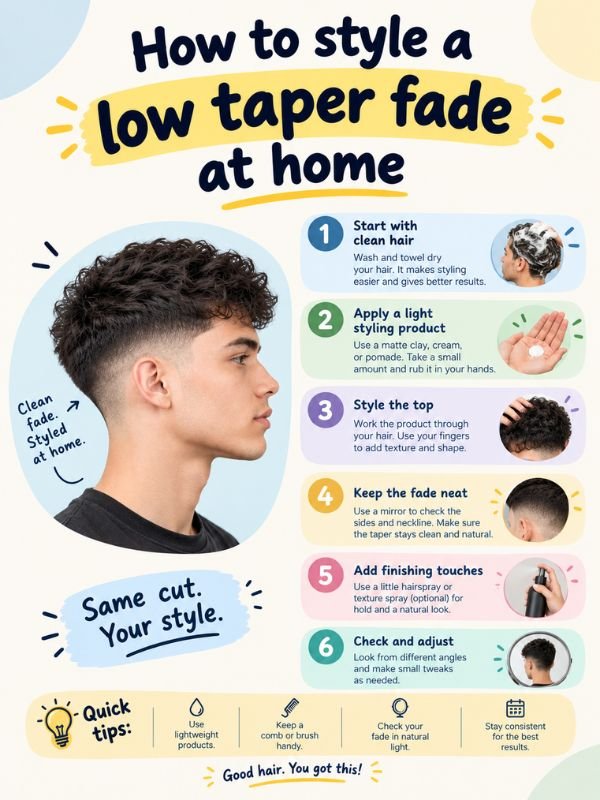
Low taper fade short hair is easy to style, but a few habits improve the result.
- Wash with a gentle shampoo. Dry scalps look flaky on short sides, so keep them moisturised.
- Towel-dry, don’t rub. Pat the hair to keep the texture intact.
- Apply a small amount of product. Pea-sized for short tops, a little more for longer styles.
- Shape with fingers or a comb. Use fingers for texture and a comb for slick styles.
- Set it. A blast of cool air from a hairdryer helps hold the shape.
Product guide:
- Clay or paste: matte, textured finish for crops and crew cuts
- Pomade: shine and control for slick backs
- Cream or mousse: soft definition for waves and curls
- Sea salt spray: light grip and volume for fine hair
Use less than you think. Too much product makes short hair look greasy.
How often to get a low taper fade touched up
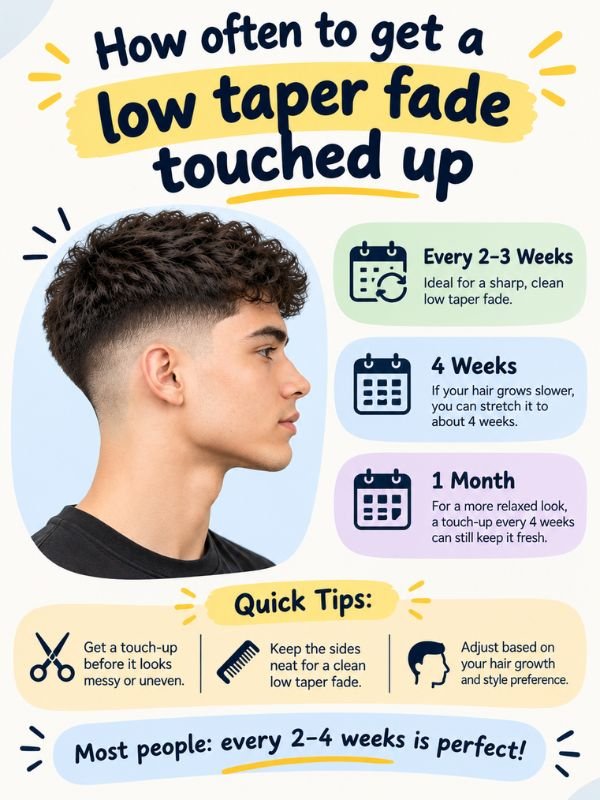
Plan for a refresh every three to five weeks. Waiting longer is fine if you like a softer, grown-out look.
| Goal | Suggested Interval |
| Razor-sharp edges | Every 2–3 weeks |
| Standard tidy look | Every 3–4 weeks |
| Relaxed, grown-out look | Every 4–6 weeks |
Between cuts, you can ask your barber for a quick neckline and sideburn clean-up. It is usually quicker and cheaper than a full cut, and it keeps low taper fade short hair looking fresh.
Conclusion
Low taper fade short hair is one of the most dependable cuts you can choose. It looks clean, grows out gracefully, and works with almost every hair type and face shape. Whether you pick a crew cut, a textured crop, a buzz cut, a slick back or a curly top, the low taper gives the finish a polished edge.
Bring a photo, describe where you want the taper to start, and keep up with a touch-up every few weeks. With a little product and a simple routine, low taper fade short hair will look sharp every day without much effort.
